
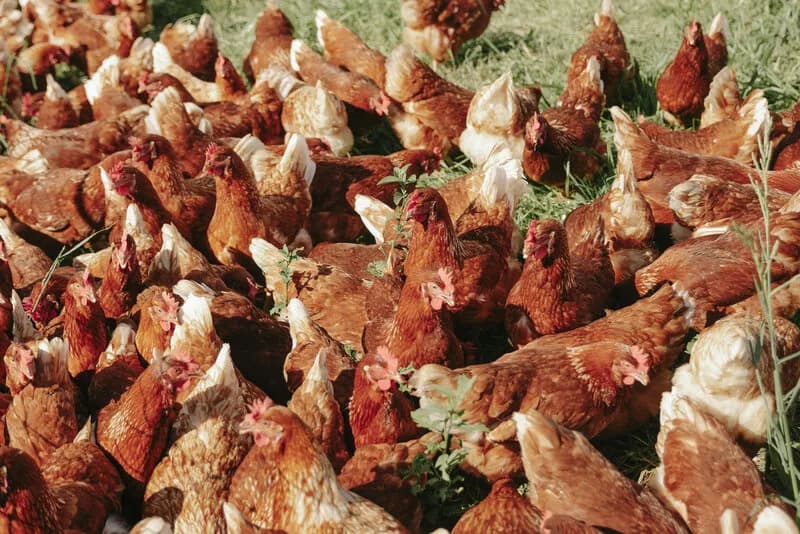
How to work out the right rotation schedule for your property
How long your birds stay in one spot, how many paddocks you're moving between and how long each section rests before the flock returns — all depend on your property, your stock density and the season. But there's a straightforward way to work it out.
Start with rest time, not move time
Most people approach rotation by asking how often they should move the birds. The better question is how long the paddock needs to recover.
In good conditions (warm months, reasonable rainfall, healthy soil) pasture typically needs 25 to 30 days of rest before the birds return. In dry or cold periods that can stretch to 60 days or more. That rest is what does the work: long enough for pasture to regrow, for parasite larvae to die off without a host and for soil biology to stabilise.
| Conditions | Typical rest before birds return |
|---|---|
| Warm months, reasonable rainfall, healthy soil | 25–30 days |
| Dry or cold periods | 60+ days |
Work backwards from there. Fix the rest you want, then divide by how often you plan to move. If you want around 28 days rest and you're moving every 4 days, you'll cycle through about 7 sections, plus the one the birds are on. Want 21 days rest at 3-day moves? Same again.
Stock density: the variable that changes everything
How hard the birds hit the ground decides how quickly they've done their work, and how quickly things go wrong if they stay too long.
As a rough guide for layer hens on pasture, 200 to 400 birds per hectare is a workable starting range for rotational systems, with moves every 3 to 5 days. Meat birds are stocked heavier and moved more often — daily moves are standard with tractors.
These are starting points, not targets. Watch the pasture. If the ground's going bare before you'd planned to move, move earlier. If it's still strong after 5 days, you've got room.
Reading the signs
The most reliable guide to your schedule is what you're seeing on the ground.
- Pasture grazed below about 5 cm: move the birds.
- Soil compacting or turning muddy around entry points: move the birds.
- Birds loafing at the fence instead of foraging: move the birds.
- A rested paddock showing strong, even regrowth: the rest period is working.
A rotation that's working has the birds foraging actively, the resting paddocks visibly recovering and your land improving season by season. If that's not what you're seeing, adjust the move frequency before you change anything else.
The infrastructure question
A schedule only holds if you can execute it. That means gear that moves quickly and doesn't take half a day to shift.
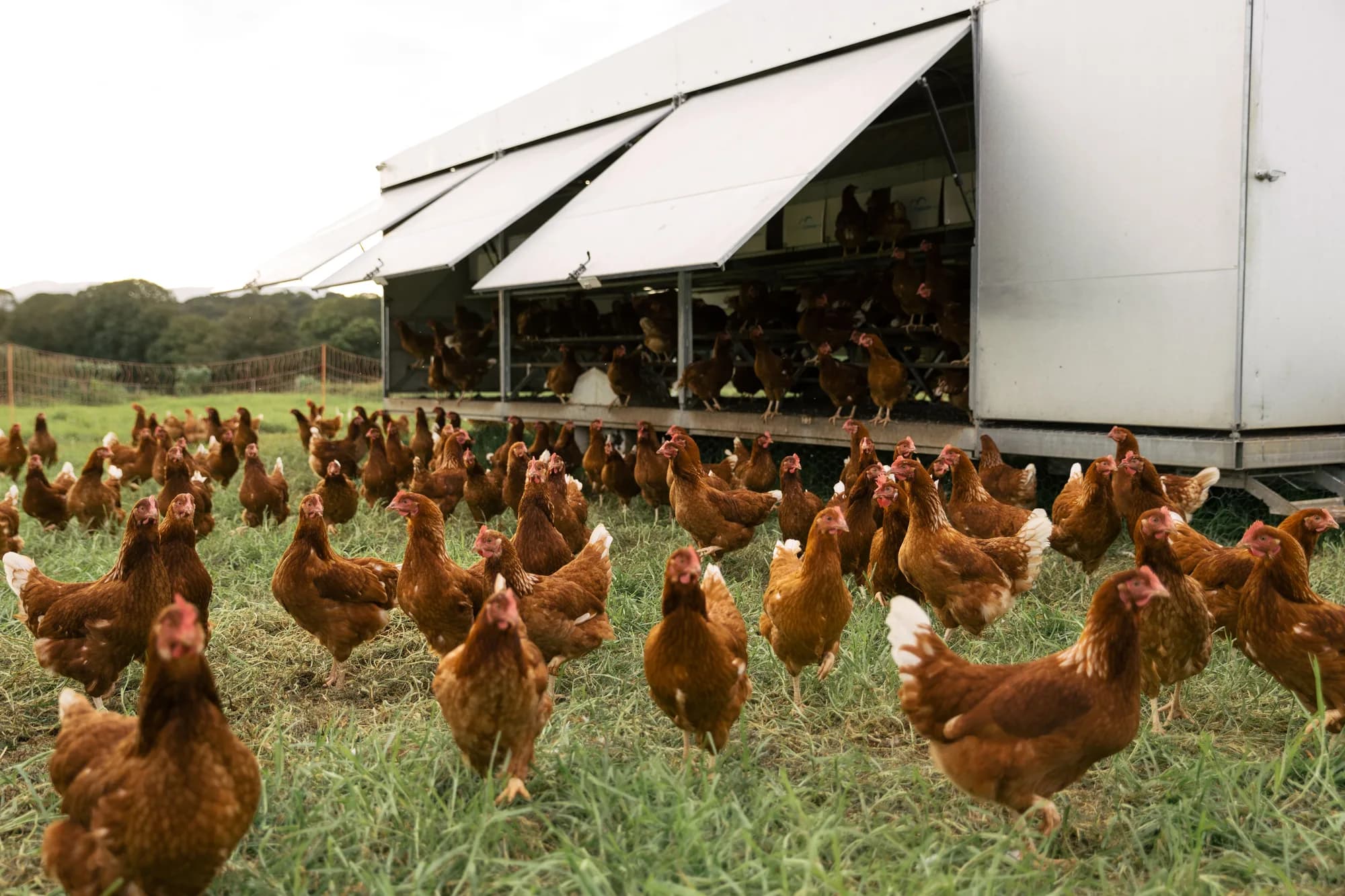
For small flocks, the CT50 Chicken Trailer can be moved by hand. For hobby farms up to 100 birds, the CT100 moves with a standard farm vehicle. Commercial operations typically pair a CT250, CT550 or CT850 trailer with a feeder trailer and IBC water system, so the whole setup moves together.
If shifting your current setup takes more than 30 minutes, the rotation will slip. It's worth fixing the infrastructure before fine-tuning the schedule.
A simple starting framework
Setting up from scratch and want somewhere to begin:
- Divide your available area into 6 to 8 sections
- Move the birds every 3 to 7 days
- Aim for 25 to 60 days rest per section
- Adjust based on what you see in the first season
Most people settle into a rhythm within a few rotations. The goal isn't a perfect schedule on paper. It's a system you'll stick to.
Common questions
How many paddocks do you need for rotational grazing?
Enough to give each one the rest you're after. A common starting point is 6 to 8 sections, moving the birds every 3 to 7 days, which lands each paddock around 3 to 4 weeks of recovery. Adjust once you see how your pasture responds.
How do you know when to move the birds?
Watch the ground and take note of recovery. Move when pasture's grazed just below your ankle (about 5 cm), when the soil's compacting or turning muddy, or when the birds start loafing at the fence instead of foraging.
What stock density works for pastured layers?
As a rough starting range, 200 to 400 layer hens per hectare with moves every 3 to 7 days. Meat birds run heavier and move daily. Treat it as a starting point and let the pasture tell you whether to ease off.
Questions about how this works with Tinkera equipment? Get in touch at hello@tinkera.com.au
More from Farming knowledge
Ready to build your rotational system?
Explore Tinkera’s range of mobile farming equipment.