
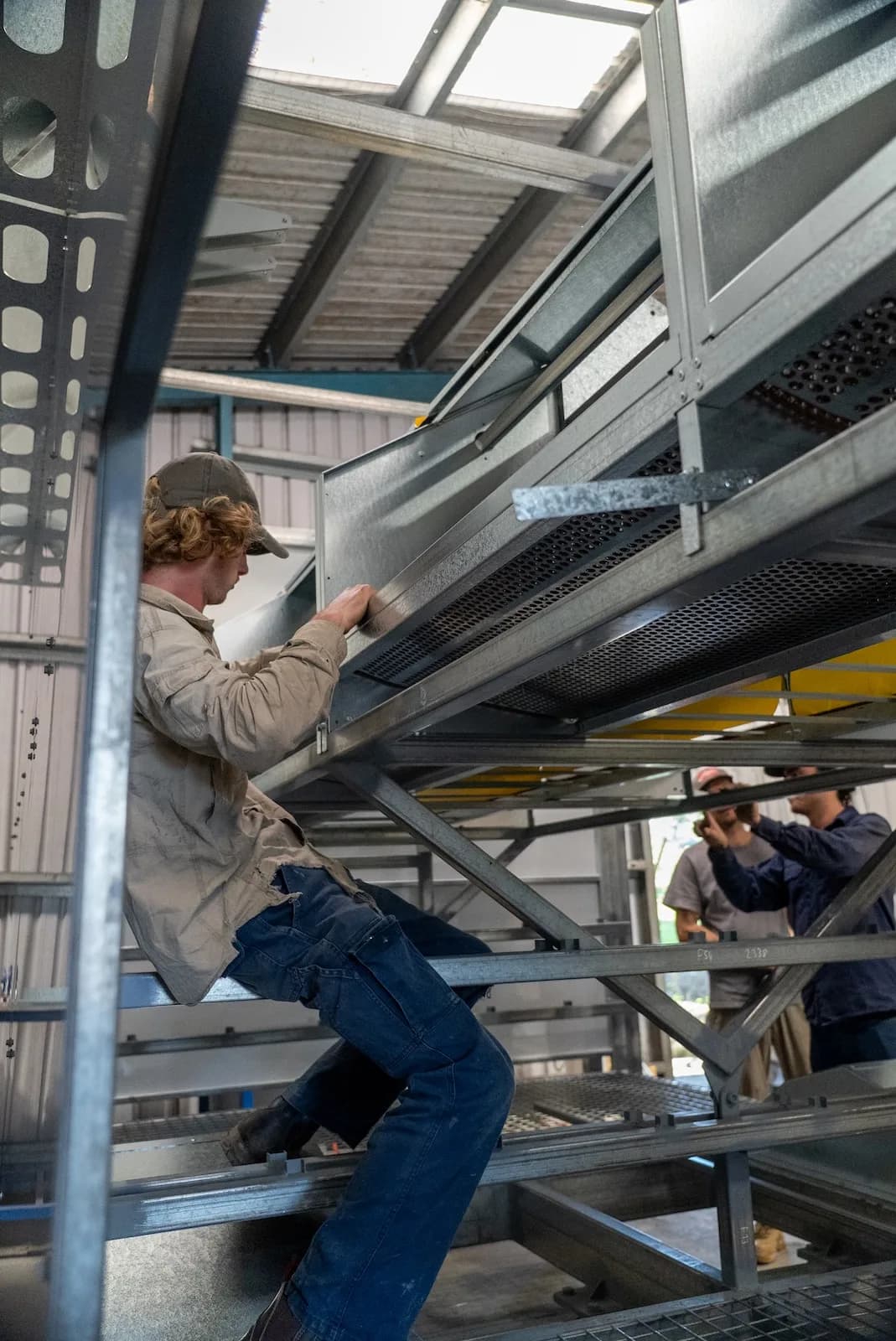
Steel fabrication in the Northern Rivers — design, prototype and production under one roof
Tinkera fabricates custom metalwork and production runs for builders, businesses and landowners across the Northern Rivers. With an industrial designer in-house, we take a rough idea or a sketch on the back of an envelope through to working drawings, a prototype and finished steel.
The range is the portfolio
Tinkera didn't start as a fabrication business. It started with a farm and a list of problems.
Oliver Bora began Oliver's Hens while he was still at school and grew it into one of northern NSW's closed-loop regenerative egg operations. The gear he needed either didn't exist, didn't hold up or cost more than the operation could carry, so he designed and built it himself. Mobile chicken coops, feeder trailers, meat bird tractors, mineral trailers and water systems — all engineered in galvanised steel and put to work in Australian conditions.
Every product in the Tinkera range went through the same process we now run for other people's jobs, which means the range doubles as the portfolio. If you want to see what comes out of the workshop, it's all on the site.
Jye Brien, our in-house industrial designer
The design side of the workshop is Jye Brien, an industrial designer who also works under his own practice, JBDesigns. He holds a Bachelor of Industrial Design with Distinction from UNSW and came up through product design consultancy in Sydney, leading projects from first sketch through to commercial product — hospitality tools, industrial hardware, injection-moulded components, sheet metal and stainless steel weldments.
That work covered the full span of getting a product made: concept sketching and form exploration, 3D CAD modelling and rendering, foam and card models, 3D printing, laser cutting, CNC milling, production drawings and coordinating the factories that built the parts. It's an unusual background for a fabrication shop, and it's the reason we can quote the design as readily as we quote the steel.
Jye's approach starts with lifecycle — making things that stay useful, that can be repaired, upgraded or remade rather than replaced, and that balance function, cost and simplicity.
It's this approach that led Oliver and Jye to collaborate on Tinkera's farm equipment. Put a designer who thinks in decades next to a workshop that builds in galvanised steel, and you get gear that's still doing its job seasons later.
You can see more of Jye's work on Instagram at @jbdesign.s.
How a design gets to production
Every job runs through the same four stages:
Design comes first. 3D CAD modelling and 2D drawings, working out clearances, loads, weld sequences and how the thing goes together before any steel gets cut. This is also where the problems get found — a bracket you can't reach with a welder, a frame that won't fit through a gate, a wall thickness doing more work than it should. Sorting those on screen costs an afternoon. Sorting them in steel costs a rebuild.
Then a prototype gets built. Not a model, not a render — the actual thing, in the actual steel, in the workshop.
Then it goes to work. For our own gear that means a paddock, a wet winter and a full rotation. For a client's product it means whatever the real conditions are. This is where most of the learning happens, because a design that works on screen and a design that works at 6am in the rain when you're on your own are two different designs. A part that looks fine in CAD can turn out to need two people to lift, or a spanner you don't own, or a hinge that fills with dust by the second season. None of that shows up on a drawing.
Only then does it go into production. The changes go back into the drawings, the drawings get built again and that's the version we sell. The first version of anything rarely is — and a shop that only builds to drawings never finds that out, because the job's gone by the time anyone uses it.
Design and fabrication on the same floor
Most fabrication shops build what they're given. We can do that — send your engineer's or architect's drawings through and we'll fabricate to them.
Having the design side in-house changes two things. We can start earlier: measure up, design the job, flag the problems before they're welded in and hand you drawings you can keep. And when something needs to change mid-job, Jye and the fabricators sort it out on the same floor in the same afternoon, rather than over three weeks of email between a drafting office and a workshop that have never met.
Prototyping is a conversation between the drawing and the steel, and it goes a lot faster when both are in the same building.
What we take on
Product development. Got an idea for a product but no way to build it? This is how Tinkera started. We design it with 3D CAD modelling and 2D drawings, prototype it in the workshop, refine it until it works and then manufacture it.
General design and fabrication. Beams, posts, lintels, stairs, balustrades and structural components for residential and commercial builds, plus the one-off custom work — frames, brackets, gates, railings and repairs. Bring us your engineer's drawings and we'll fabricate to them, or bring us a photo and a rough idea and we'll work it out with you.
Metal manufacturing. Repeat runs and production work — components, assemblies and fittings manufactured to spec, consistent from the first unit to the last. If you need fifty of something rather than one, this is where we're set up to help.
We work in mild steel, galvanised steel, stainless steel and aluminium.
Where we work
We're based in the Northern Rivers and service Ballina, Byron Bay, Mullumbimby, Bangalow, Lennox Head, Lismore, Alstonville and the wider region. Larger structural jobs further afield are worth a conversation.
Common questions
Can you design something if I've only got an idea? Yes. That's product development, and it's where having a designer in-house matters most. A sketch, a photo or a description is enough to start — we design it, prototype it, refine it and manufacture it.
Who does the design work? Jye Brien, our in-house industrial designer. He works in 3D CAD and 2D drawings and has a background in product design consultancy, taking products from concept through to manufacture.
How long does product development take? It depends on how many rounds the design needs. Simple components can move from drawing to production quickly. Anything with moving parts, load requirements or field conditions usually takes at least one prototype and one round of changes. We'll give you a realistic run at it after the first conversation.
Do I need engineering drawings before I get in touch? No. If you have them, send them and we'll fabricate to them. If you don't, that's the part we can do.
Do you do small one-off jobs? Yes. One-off brackets, frames, gates and repairs sit alongside the larger structural and manufacturing work.
Can you fabricate farm equipment that isn't in the Tinkera range? Yes — custom rural gear, repairs and modifications are a specialty. It's what the workshop was built around.
Tell us about the job
Attach drawings, plans or a photo of a sketch. Send it through and Oliver will give you a call to talk it through.
Find out more → Steel fabrication
Or email hello@tinkera.com.au. Oliver reads everything.
Ready to build your rotational system?
Explore Tinkera’s range of mobile farming equipment.