
Starting a pastured egg business: what we learned building Oliver's Hens
Starting a pastured egg business comes down to six things: a flock big enough to pay its way, housing that moves with the pasture, feed and water that move with it, fencing that keeps the foxes out, the right licence and somewhere to sell your eggs. Get those sorted before the hens arrive and the day-to-day runs a lot smoother. Here's what we learned building Oliver's Hens from a school project into a working egg business in northern NSW.
How Oliver's Hens started
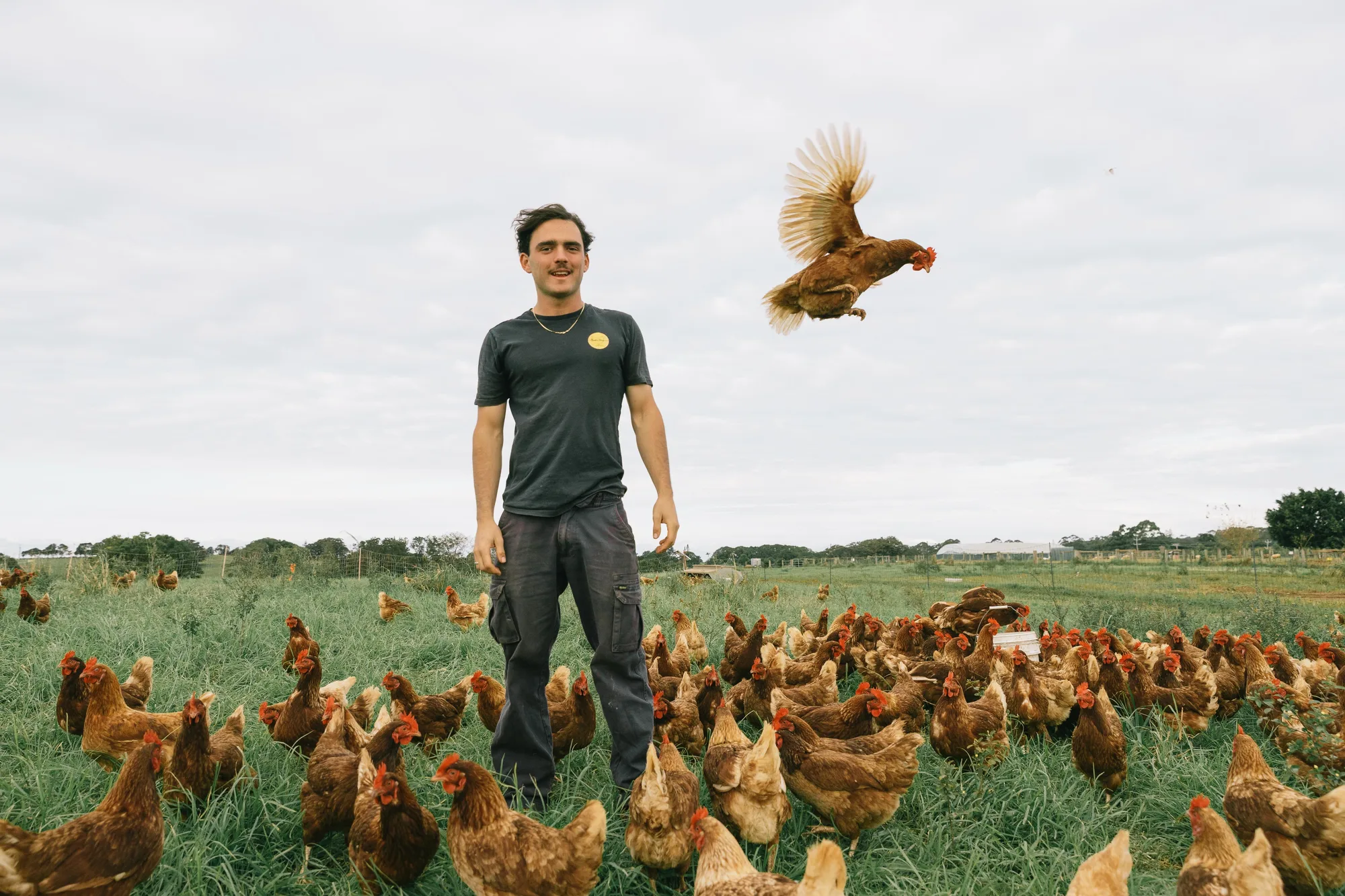
Oliver started keeping hens in his final year of high school, kicking things off with a crowdfunding campaign, and founded Oliver's Hens in 2018. What began as a small flock is now around 2,000 pasture-raised hens supplying homes, shops and restaurants across the Northern Rivers.
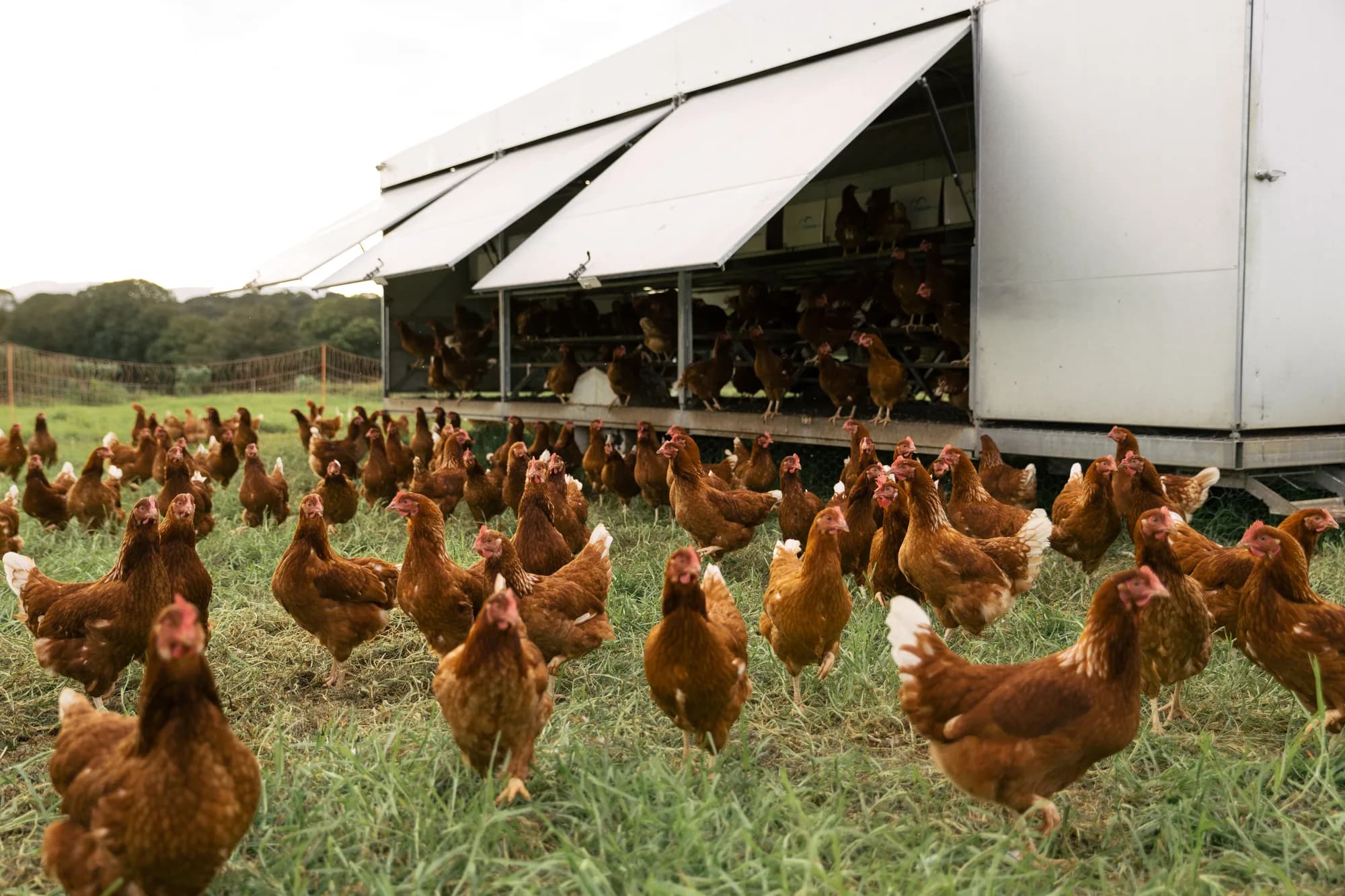
The hens live on pasture at The Farm near Byron Bay and share the paddocks with grass-fed cattle at Leela Farm in the Myocum Valley. They live in mobile coops and move onto fresh pasture every few days. Most of the gear that makes that possible was designed and built by Oliver himself, because he couldn't buy what he needed. That gear became Tinkera.
What you need to start a pastured egg business
- A flock size with a plan behind it. Know roughly how many eggs you can sell before you buy the birds.
- Mobile housing. A coop or trailer sized to the flock, built to move often.
- Feed and water that move too. Sized to the flock, so you're not doing bucket runs every day.
- Fencing. Electric netting that moves with the rotation.
- A licence or registration. The rules depend on your state and how many eggs you sell.
- Somewhere to sell. Ideally more than one channel.
Pick a flock size that pays
A backyard flock and an egg business are different animals. Below about 100 birds, eggs usually cover the feed bill and not much more. The jump to a business happens when the flock is big enough that the time you spend each day is worth it.
That's why the gear changes as the flock grows. Up to 100 birds, a hobby trailer like the CT50 or CT100 does it all, with feeders and drinkers built in. At around 250 birds, the CT250 is where pasture-raised egg production gets serious: a heavier build, a bigger solar system and an isolated egg-collection room. From there the CT550, CT850 and CT1150 cover mid to large commercial flocks.
Not sure where you sit? The flock size guide matches every flock size to the right setup.
Housing that moves with the pasture
Moving the flock is the whole point. When hens stay in one spot, the ground gets hammered. When they move every few days, they get fresh pasture, the paddock gets an even spread of manure and the ground gets time to recover. Disease and parasite pressure drops because the birds don't sit on the same ground long enough for problems to build up.
That only works if moving the coop is easy. If it's a half-day job, it won't happen as often as it should. A trailer that hitches up and shifts in minutes is what keeps the rotation going in a busy week. Oliver's hens move onto fresh ground every few days. As a starting point for layers, moves every 3 to 4 days give each section of paddock around 21 to 28 days to rest before the birds come back. In dry or cold spells it can take longer. Watch the pasture: if it's grazed below about 5cm, move early. The full working is in our rotation schedule guide.
Feed and water: the part that catches people out
Housing gets the attention, but a mobile setup is three things moving together: housing, feed and water. Size the coop without sizing the rest and you end up hauling buckets every day.
Above about 250 birds, a feeder trailer carrying 1 or 1.5 tonnes cuts refills right down and keeps the feed dry under cover. An IBC water trailer carts 1,000L of water to wherever the birds are, and a nipple drinker skid gets it to the flock clean. When the coop moves, the feed and water move with it.
Fencing and foxes
Electric netting does two jobs. It keeps the hens where the rotation needs them and it keeps foxes, dogs and other predators out. Size the netting to the flock and the area you want them on, and move it with the coop. A good energiser and a regular check of the fence line are cheaper than losing birds.
The paperwork
The rules depend on where you farm, so check your own state before you sell a single egg. In NSW:
- Over 240 eggs a week (20 dozen): you need an egg producer licence from the NSW Food Authority.
- 240 eggs a week or fewer: no licence, but you still need to notify the Food Authority of your business details.
- Either way: eggs sold in NSW need to be individually stamped with your unique identifier.
Other states have their own systems, so check with your state's food safety authority. Talk to your council about zoning before you buy stock too.
Be careful with the words on your carton. "Free range" has a legal definition in Australia that includes outdoor stocking density, and any claim you make about how your hens are raised has to be true.
Selling your eggs
Most small egg businesses sell through more than one channel: farmers' markets, local cafes and restaurants, grocers, an honesty box at the gate or direct to households. Pastured eggs sell on the story, so tell it. Show people the paddock, the hens and the coop moving across the grass.
Oliver's Hens sells at the local farmers' markets, including Mullumbimby on Friday mornings and Byron Bay on Thursdays, and through a long list of local grocers, health food shops and restaurants across the Northern Rivers. Markets are where people meet the farmer and hear the story. Shops and restaurants give you steady weekly orders. Running both means one quiet week doesn't sink you.
What Oliver would tell someone starting out
Years of trial and error on his own paddocks taught Oliver what holds up. A few things stand out:
- Plan the system, not just the coop. Housing, feed, water and fencing all need to move together. Most of what became Tinkera started as gear Oliver built because he couldn't buy it.
- Make moving easy. The rotation only works if a move fits into a busy day.
- Use everything. At Oliver's farm, the hens share the paddocks with cattle and nothing from the birds goes to waste. A closed loop is better for the land and better for the books.
- Scale in steps. Get one flock running well before you add the next.
"I want to share what I've learnt, so more people can farm, eat and live with a real connection to the land," Oliver says. "It doesn't need to be complicated. It just takes the right setup and someone to show you how."
Common questions
How many hens do I need to start an egg business? It depends on how many eggs you can sell. Many people start with 100 to 250 birds and scale up once their sales channels are steady. Below about 100 birds, it's usually a hobby that pays for its feed.
Do I need a licence to sell eggs in NSW? If you produce more than 240 eggs a week, yes: you need a licence from the NSW Food Authority. Below that, you notify the Food Authority instead. Either way, eggs sold in NSW must be stamped.
How often should I move a mobile chicken coop? Every few days is a good rhythm for most flocks. Move sooner if the ground is looking bare, and give each patch time to recover before the flock comes back.
Can I start small and scale up? Yes. Start with one trailer and add more as your sales grow. Each flock runs as its own unit, with its own housing, feed and water moving together.
Thinking about turning a flock into a business? Get in touch at hello@tinkera.com.au. Oliver reads everything.
Learn more about Oliver's Hens or Chicken trailers.
More from Farming knowledge

Ready to build your rotational system?
Explore Tinkera’s range of mobile farming equipment.